

Last technically reviewed: October 2026 · By the PartnerPPE product team
In short
- EN ISO 20471:2013+A1:2016 has three classes. A Class 3 garment needs at least 0.80 m² of fluorescent background and 0.20 m² of retroreflective material. Class 2 needs 0.50 m² and 0.13 m², and Class 1 needs 0.14 m² and 0.10 m².
- ANSI/ISEA 107-2020 sorts garments by Type (O off-road, R roadway, P public safety) and by Performance Class (1, 2, 3, plus supplemental Class E).
- Type R Class 3 under ANSI needs at least 1,240 in² of background and 310 in² of retroreflective material. This is the same quantity as EN Class 3 (0.80 m² and 0.20 m²), expressed in square inches.
- EN ISO 20471 permits fluorescent yellow, orange-red and red backgrounds. ANSI/ISEA 107 permits fluorescent yellow-green, orange-red and red.
- The lowest-scoring material area sets the class. A combination of garments, such as a jacket with trousers, can reach a higher class than either garment alone if the manufacturer certifies and declares that combination.
What is EN ISO 20471?
EN ISO 20471 is the European and international standard for high-visibility clothing for professional use. The current reference is EN ISO 20471:2013 with Amendment A1:2016. It is listed as a harmonised standard under the EU PPE Regulation (EU) 2016/425. The standard classifies garments by the minimum visible area of two materials:
- Fluorescent background material, which gives conspicuity in daylight.
- Retroreflective material, which returns vehicle headlight to the driver at dusk and at night.
Areas are measured on the smallest size in the range. The garment’s class is set by whichever of the two materials falls lowest. Retroreflective bands must be at least 50 mm wide, and background material must encircle the torso and, where present, the sleeves and trouser legs.
| EN ISO 20471 class | Min. fluorescent background | Min. retroreflective | Typical use |
|---|---|---|---|
| Class 3 | 0.80 m² | 0.20 m² | Highest visibility: high-speed roads, night work, poor visibility |
| Class 2 | 0.50 m² | 0.13 m² | Intermediate risk: urban road works, construction near traffic |
| Class 1 | 0.14 m² | 0.10 m² | Lowest risk: off-road areas, low-speed sites |
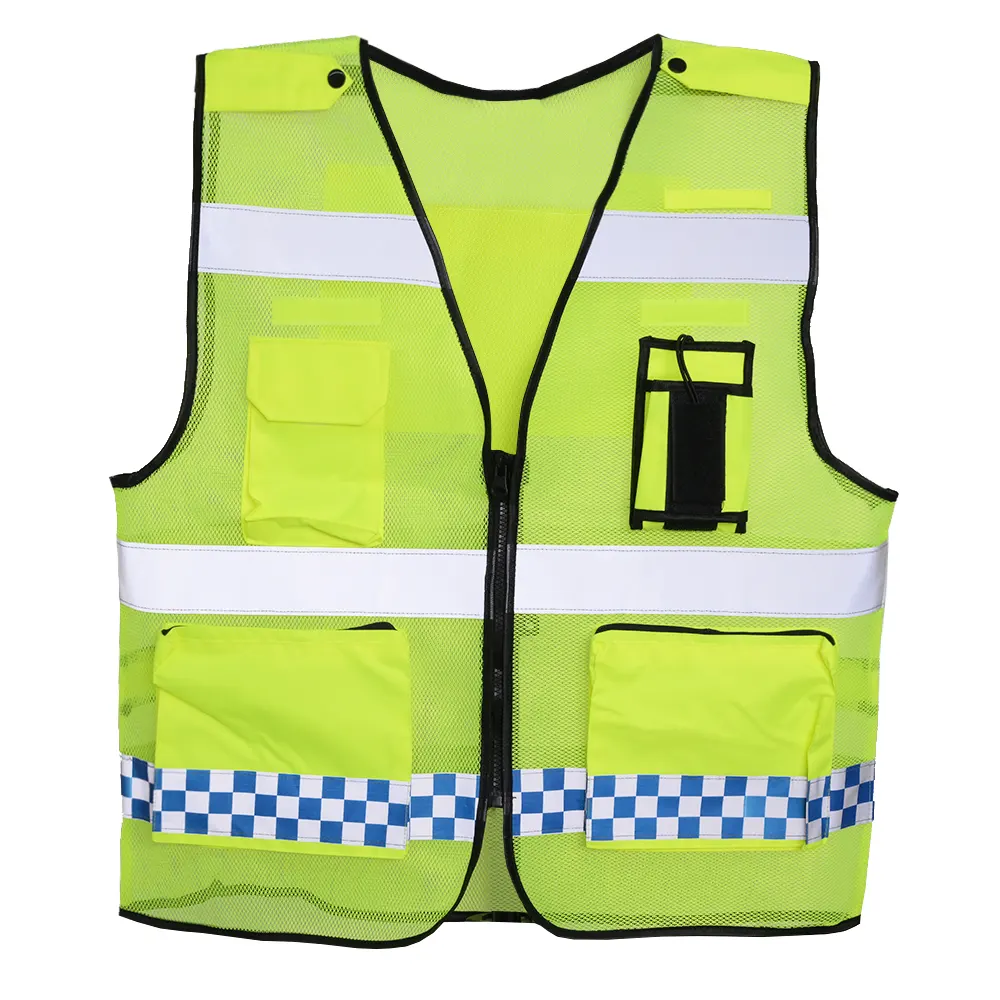
Class 3 has an additional rule. The garment must cover the torso and have either sleeves with retroreflective bands or full-length trouser legs with bands. In practice this means a sleeveless vest is limited to Class 1 or Class 2, and a Class 3 rating calls for a sleeved jacket or a declared jacket-and-trouser combination.
What is ANSI/ISEA 107-2020?
ANSI/ISEA 107 is the American National Standard for High-Visibility Safety Apparel. The 2020 edition defines three garment types:
- Type O (off-road), Class 1 only. For workers who are not exposed to public roadway traffic but are near moving vehicles or equipment, such as warehouse, parking and yard staff.
- Type R (roadway), Class 2 or 3. For workers exposed to roadway traffic or work-zone equipment.
- Type P (public safety), Class 2 or 3. For police, fire and EMS personnel who need access to equipment on their body. Type P has lower background minimums than Type R.
Class E covers supplemental items such as trousers, shorts and gaiters. A Class E item cannot be worn alone as compliant apparel. Worn with a Class 2 or Class 3 top, the ensemble is rated Performance Class 3.
| ANSI/ISEA 107-2020 | Min. background (in²) | Min. retroreflective (in²) | Approx. metric equivalent |
|---|---|---|---|
| Type O, Class 1 | 217 | 155 | 0.14 m² / 0.10 m² |
| Type R, Class 2 | 775 | 201 | 0.50 m² / 0.13 m² |
| Type R, Class 3 | 1,240 | 310 | 0.80 m² / 0.20 m² |
| Type P, Class 2 | 450 | 201 | 0.29 m² / 0.13 m² |
| Type P, Class 3 | 775 | 310 | 0.50 m² / 0.20 m² |
| Class E (supplemental) | 465 | 109 | 0.30 m² / 0.07 m² |
For the smallest size only, Type R Class 2 may use 540 in² of background and Type R Class 3 may use 1,000 in². Retroreflective minimums are not reduced. ISEA opened a public review of a revised ANSI/ISEA 107 draft in March 2026, so check the edition named on the label and in your specification.
EN ISO 20471 vs ANSI/ISEA 107: key differences
| Point | EN ISO 20471:2013+A1:2016 | ANSI/ISEA 107-2020 |
|---|---|---|
| Classification | Class 1, 2, 3 | Type O/R/P combined with Class 1, 2, 3, plus Class E |
| Area units | m² | in² |
| Background colours | Fluorescent yellow, orange-red, red | Fluorescent yellow-green, orange-red, red |
| Public-safety variant | None; same classes for all users | Type P, with lower background minimums |
| Flame resistance | Not covered; certified separately to a flame standard | “FR” may be claimed only if the item fully meets a listed ASTM or NFPA standard. Other items must be labelled non-FR. |
| Regulatory link | Harmonised under EU Regulation 2016/425 | Type R is the type used for US roadway work under the MUTCD |
Flame-resistant hi-vis
A hi-vis rating says nothing about flame or arc protection. In Europe, flame-resistant hi-vis is certified to EN ISO 20471 and also to a separate flame standard such as EN ISO 11612 (heat and flame). Where the hazard calls for it, garments may also be certified to IEC 61482-2 (electric arc) or EN 1149-5 (electrostatic). Under ANSI/ISEA 107-2020, an item can be labelled FR only if it meets one of the listed standards in full: ASTM F1506, F1891, F2302 or F2733, or NFPA 1977 or 2112. For oil and gas, utilities and welding-adjacent work, specify the flame or arc standard as well as the hi-vis class.
How to choose
- Warehouses, ports and logistics yards (no public traffic): EN Class 1 or Class 2 vest, or ANSI Type O Class 1. Choose Class 2 if forklifts and trucks run at speed or lighting is poor.
- Urban road works and construction sites next to traffic: At least EN Class 2 or ANSI Type R Class 2.
- Highways, night work and bad weather: EN Class 3, which in practice means a sleeved jacket or a declared jacket-and-trouser combination, or ANSI Type R Class 3. Add Class E trousers for night shifts.
- Police, fire and EMS: ANSI Type P, or EN Class 2 or 3 in markets that follow EN.
- Colour: Pick the colour that contrasts most with the background. Orange-red often stands out better than yellow against foliage or snow.
- Export projects: Tenders in Africa and the Middle East may specify either standard. Match the standard, class and colour exactly as written, and ask for the test report covering that specific model.
For a full kit specification, footwear has its own EU and North American standards. See our comparison of ASTM F2413 vs EN ISO 20345 vs CSA Z195.
Frequently asked questions
Is ANSI Class 3 the same as EN ISO 20471 Class 3?
The minimum areas are numerically equivalent: 1,240 in² of background and 310 in² of retroreflective material is 0.80 m² and 0.20 m². The two standards still differ in colours, test methods and design rules, so a garment needs certification to each standard it claims.
Can a hi-vis vest be Class 3?
Not under EN ISO 20471 on its own. Class 3 requires torso coverage plus sleeves with retroreflective bands, or full-length trousers with bands. Most vests are therefore certified Class 1 or Class 2.
Does a Class 2 jacket plus hi-vis trousers make Class 3?
It can, under either standard, but only if the combination has been assessed and is declared in the user information. Under ANSI, a Class E item worn with a Class 2 or 3 top gives Performance Class 3.
Can PartnerPPE supply hi-vis vests and jackets to EN ISO 20471 or ANSI/ISEA 107?
Yes. We supply hi-vis vests, jackets and trousers made to EN ISO 20471 or ANSI/ISEA 107 requirements, in the colours your market requires. We can provide test reports for certified models on request and arrange third-party testing for OEM and private-label orders. Hi-vis can be consolidated in one shipment with helmets, gloves, eyewear and safety footwear. Browse our hi-vis vests and workwear, or send us your tender specification.
Sources: EN ISO 20471:2013+A1:2016; ANSI/ISEA 107-2020; Commission Implementing Decision (EU) 2026/1279 (harmonised PPE standards); 3M Scotchlite and 3M “ANSI 107-2020 Made Easier” technical summaries; ISEA public-review notice (March 2026). This article is a buyer’s summary, not a substitute for the standard text. Always confirm requirements against the current edition and your local regulations.