
Last technically reviewed: October 2026 · By the PartnerPPE product team
In short
- EN 388:2016+A1:2018 marks gloves with a code of up to six characters, in this order: abrasion (0–4), coupe cut (0–5), tear (0–4), puncture (0–4), ISO 13997 cut (A–F), and impact (P).
- Under ISO 13997, the cut letter is set by the blade force needed to cut through the material. A needs at least 2 N, B 5 N, C 10 N, D 15 N, E 22 N and F 30 N.
- If the material blunts the coupe test blade, the ISO 13997 letter becomes the reference cut result, and the coupe digit is often shown as “X”.
- “X” means a test was not performed or is not applicable. “P” means the glove passed the optional impact test.
- In North America, ANSI/ISEA 105 uses cut levels A1 to A9, from 200 g to at least 6,000 g. The current edition is ANSI/ISEA 105-2024, published November 2024.
What is EN 388?
EN 388 is the European standard for protective gloves against mechanical risks. The current version is EN 388:2016+A1:2018, which is harmonised under the EU PPE Regulation (EU) 2016/425. A compliant glove shows the shield pictogram with a hammer, and the performance code is printed beneath it.
The 2016 revision made two main changes to cut testing. It added the ISO 13997 “TDM” straight-blade test with letter grades, and it introduced an optional impact test. The older circular-blade “coupe” test is still in the standard. However, it can give misleading results on modern high-performance yarns that contain glass fibre, steel or HPPE, because these materials blunt the coupe blade.
EN 388 performance levels
| Position | Test | Level 1 | Level 2 | Level 3 | Level 4 | Level 5 |
|---|---|---|---|---|---|---|
| 1 | Abrasion (cycles) | 100 | 500 | 2,000 | 8,000 | – |
| 2 | Coupe cut (index) | 1.2 | 2.5 | 5.0 | 10.0 | 20.0 |
| 3 | Tear (N) | 10 | 25 | 50 | 75 | – |
| 4 | Puncture (N) | 20 | 60 | 100 | 150 | – |
Level 0 means the glove fell below Level 1. “X” means the test was not carried out or is not applicable to that glove.
Coupe test vs ISO 13997: how cut is graded
The coupe test runs a rotating circular blade back and forth over the sample under a light load. The result is an index relative to a cotton reference fabric. Under EN 388:2016, if the material blunts the blade, the ISO 13997 test must be performed and its letter becomes the reference cut result.
The ISO 13997 (TDM) test draws a straight blade across the sample once under a known load. It finds the force needed to cut through over a fixed reference distance. The result is reported in newtons and graded A to F.
| ISO 13997 letter | Min. cutting force | ≈ grams-force (arithmetic only) | Nearest ANSI/ISEA 105 level threshold |
|---|---|---|---|
| A | 2 N | ≈ 204 g | A1 (200 g) |
| B | 5 N | ≈ 510 g | A2 (500 g) |
| C | 10 N | ≈ 1,020 g | A3 (1,000 g) |
| D | 15 N | ≈ 1,530 g | A4 (1,500 g) |
| E | 22 N | ≈ 2,243 g | A5 (2,200 g) |
| F | 30 N | ≈ 3,059 g | A6 (3,000 g) |
The thresholds line up closely once newtons are converted to grams-force (1 N ≈ 102 gf). This is not an official equivalence, though. EN 388 uses ISO 13997 and ANSI/ISEA 105 uses the ASTM F2992 method, and the two procedures differ. A glove needs a test report against each standard it claims.
Reading a code: “4X43D” means abrasion level 4, coupe not applicable (blade blunting), tear level 4, puncture level 3, and ISO 13997 grade D (at least 15 N). “4542EP” means abrasion 4, coupe 5, tear 4, puncture 2, ISO cut E, and impact passed.
Impact protection (P)
The impact test is optional and is meant for gloves with padding on the back of the hand. A 5 J impact is applied, and the transmitted force must average no more than 7.0 kN, with no single result above 9.0 kN. A pass is marked “P”. Gloves without impact claims show nothing in the sixth position, or an “X”. In North America, impact gloves are rated to a separate standard, ANSI/ISEA 138, which uses levels 1 to 3.
ANSI/ISEA 105 cut levels A1–A9
| ANSI cut level | Grams to cut | ANSI cut level | Grams to cut |
|---|---|---|---|
| A1 | 200–499 | A6 | 3,000–3,999 |
| A2 | 500–999 | A7 | 4,000–4,999 |
| A3 | 1,000–1,499 | A8 | 5,000–5,999 |
| A4 | 1,500–2,199 | A9 | 6,000+ |
| A5 | 2,200–2,999 | ||
ANSI/ISEA 105-2024 keeps the A1–A9 cut scale used in the 2016 edition. It extends the scope to sleeves (arm protection) and adds a pentagon-shaped marking that shows the cut, abrasion and puncture levels together.
Coatings: nitrile, latex and PU
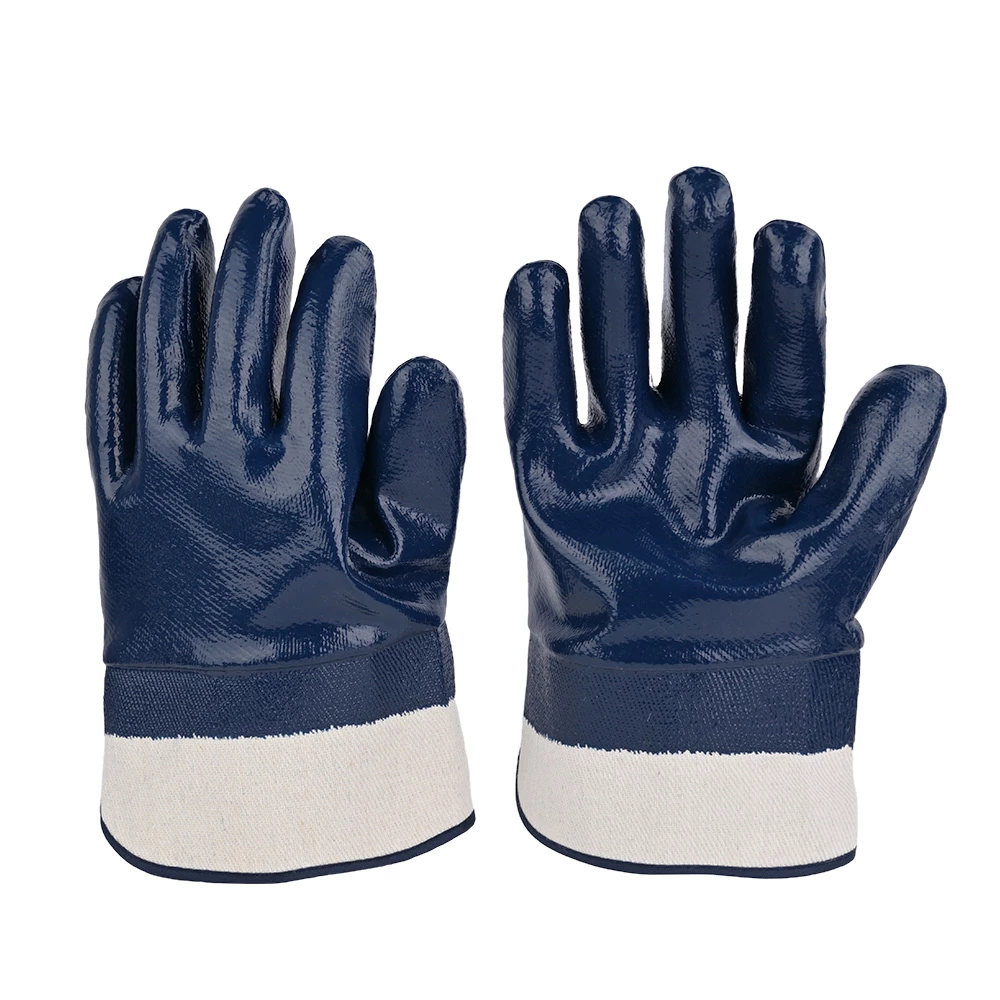
- Nitrile (smooth, foam or sandy finish): good abrasion resistance and the best general choice where oil or grease is present. It is common on cut-resistant liners.
- Latex (often a crinkle finish): strong grip and flexibility for rough, wet handling such as bricks and blocks. Natural rubber latex can cause allergies in some users.
- PU (polyurethane): a thin, light coating with high dexterity. It suits dry or lightly oily assembly, inspection and small-parts work, but is less durable under heavy abrasion.
How to choose
| Task | Typical starting specification |
|---|---|
| General handling, warehousing, logistics | Abrasion 3–4, cut A–B (A1–A2), nitrile or PU palm |
| Construction, bricklaying, rebar | Abrasion 4, tear 3–4, latex or sandy nitrile coating |
| Sheet metal, stamping, cable trays | Cut C–E (A3–A5), nitrile coating for oily parts |
| Glass handling, recycling, sharp blades | Cut E–F (A5 and above), with cut-resistant sleeves where forearms are exposed |
| Oil and gas, mining, heavy rigging | Impact “P” (or ANSI/ISEA 138), high abrasion and tear ratings, oil-grip nitrile |
These are starting points only. The final choice should follow a task risk assessment and a wearer trial for fit and dexterity. A higher cut letter usually comes with a thicker liner and some loss of tactile feel.
Frequently asked questions
Which matters more: the coupe number or the ISO 13997 letter?
For high-performance cut yarns, the ISO 13997 letter. If the material blunts the coupe blade, the letter becomes the reference result. Most buyers now specify cut by the letter, for example “EN 388 cut level D minimum”.
What does “X” mean on an EN 388 glove?
The test was not performed or is not applicable. In the coupe position, an X usually means the blade blunted and the ISO 13997 letter applies instead.
Is EN 388 cut level F the same as ANSI A6?
The thresholds are close (30 N is about 3,059 g, and A6 starts at 3,000 g). However, the two use different test methods, so a glove must be tested to each standard before it can be marked for both.
Can PartnerPPE supply cut-resistant and coated gloves to EN 388 or ANSI/ISEA 105?
Yes. We supply nitrile-, latex- and PU-coated gloves and cut-resistant gloves made to EN 388 or ANSI/ISEA 105 requirements, from general handling to high cut grades. We can provide test reports for certified models on request and arrange third-party testing for OEM orders. Gloves can be shipped together with other PPE categories in one consolidated order. See our work gloves or send us your required EN 388 code.
Sources: EN 388:2016+A1:2018; EN ISO 13997; ANSI/ISEA 105-2016 and ANSI/ISEA 105-2024 (ANSI blog summary); ANSI/ISEA 138-2019; technical guides from SATRA, Ejendals, PIP and BIMEO; Commission Implementing Decision (EU) 2026/1279. This article is a buyer’s summary, not a substitute for the standard text. Gram conversions are arithmetic aids only, not official equivalences.